
Tag Archive | "East Tremont"

A ministry for a hurting community

Pastor Rebecca Vega (right) and her sister, Jacqueline Quinones (left), start the first service in the House of Healing's new location. (KIRAN ALVI/The Bronx Ink)


The worshippers who crowded into the living room of the two-bedroom apartment on Marmion Avenue in East Tremont had known more than their share of losses and hardships. Their neighborhood has been through some tough times.

On Aug. 24, a stray bullet on East 174th Street killed Yaritza Pacheco, 24. On Aug. 30, three people, ages 5, 2 and 20, were shot on 180th Street.  The next day, Phillip Richards, 35, was gunned down on East 181st Street. On Sept. 17, India Durant, 3, died after being found unconscious in her family’s home on East 180th Street. Kurt Lawrence, 17, was found with a gunshot wound to his chest on Nov. 26 on East 175th Street.

But Pastors Anthony and Rebecca Vega, both 35 and married for 14 years, offer hope and healing in their ministry, which recently moved from their apartment into a location four times the size at 921 East Tremont Ave. On most Sundays, it was a struggle to fit the usual 60 worshippers into their apartment so the new location offers new opportunities for serving the community, they say.

“We’re here to help everyone,” said Rebecca Vega, who has two boys of her own. “There’s especially no place for the youth to go around here. Nothing is free, and we want to give them things to be happy about.”

Those things include preaching to youth members at a Juvenile Detention Center in Westchester once a month and hosting community events geared towards children. On Nov. 12, they hosted a glow-in-the-dark service in Tremont Park, the same location where they handed out book bags and school supplies to anyone who came back in September—all funded with their own money and church donations. The Vegas even let youth members lead services on Fridays.

“What else do they have?” Rebecca Vega said. “It’s hard growing up in an environment where not only do you not have a lot, but then things, people get taken from you too.”

The Vegas know what it is like. In 2005, their seven-year-old daughter, Abigail, died of acute metabolic acidosis, a condition in which the body either produces too much acid or the kidneys do not remove enough from the body. But after a part of their family “broke away,” Anthony Vega said, they were able to help join others.

Rebecca Vega and her sister, Jacqueline Quinones, start the service with Spanish-language religious songs. Neither is shy with volume. And as some congregationalists play tambourines and drums, others loudly sing along, falling into a trance with the rhythmic melodies. The hand-holding, emotion-filled room gears up the church for the equally lively sermon given by Anthony Vega and Quinones’ husband, Melvin.

“It’s like a family here and they really care about us, it’s like they’re our friends,” said Joanna Garay, 15, who joined the church in 2010 after stumbling upon a picnic the ministry had outside the apartment building. “There are so many kids doing the wrong things around this area but kids like it here so they come and can stay out of trouble.”

“The church brought my family together,” said Garay, who did not come from a churchgoing family but has not missed a service since she first attended. “And now it feels like the church and everyone in it are my family.”

Garay’s mother went with her daughter one day and then forced her other daughter, Valerie Lovo, to come. Today, Lovo is also an active member and led a service in the orange-painted living room on Oct. 14.

Joanna Castro, 30, of Staten Island said that the living room in the Bronx changed her life.

She found out about the House of Healing through a friend in 2006 and used to make the hour-long drive on Sundays. The pastors helped her find the confidence to get out of an abusive 13-year relationship in a year ago. On Oct. 2, after packing up the painful memories of Staten Island, she moved into an apartment Rebecca Vega helped her find, just four blocks away from the ministry.

“I held on too long to the pain and the hardships I endured,” Castro said. “The pastors just told me that God has bigger plans for you and they helped me get out of it.”

The neighborhood is home to many residents who have a lost many things, including hope, Anthony Vega said. “Then they end up making the wrong choices, and through God and positivity we want to help them find the strength to get through it.”

Instead of walking through their apartment door every weekend, the ministry’s more than 60 people—almost half of whom are under 12 years old—will now be walking into a building and onto the second floor of a new House of Healing.

“We’ve moved into our new location, but we don’t want the feeling to change,” Anthony Vega said seated in his now-empty living room. “We’re going to put a sign outside that reads ‘Welcome Home.’”

“We’re not healed,” he  said. “So we want to help others heal and maybe we can all heal together. Not all is lost.”

Posted in Bronx Neighborhoods, Multimedia, North Central Bronx, VideoComments (0)

MS Ventura sits at table with cabinet

Running for president of the Dominican Republic–from the South Bronx

Ventura standing in front of the salsa club

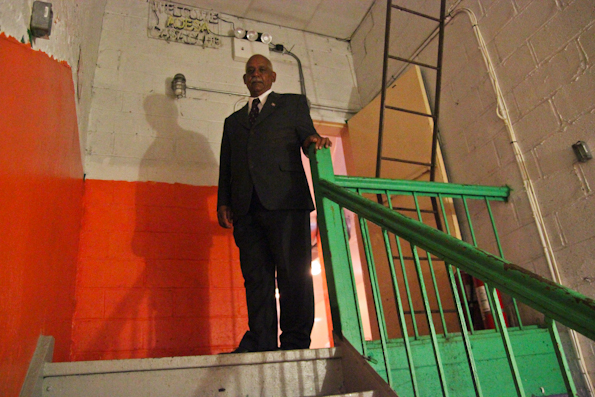
Real estate broker turned Bishop turned presidential candidate of the Dominican Republic, Roberto Quevedo Ventura, stands outside a salsa club before his party's Saturday night meeting. (KIRAN ALVI/The Bronx Ink)

Every Saturday night, 27 local residents meet in an abandoned salsa club in East Tremont to discuss Dominican Republic politics. The various clergymen, business people, and housewives are intent on getting the Bishop in their midst elected as the island’s next president in May.

These Dominican expatriates have little campaign money, and even less political clout. Still they feel so strongly about the the chaos and poor education choices back home, they have convinced themselves that Bishop Roberto Quevedo has the moral backbone and business experience to win.

“I trust Quevedo because he cares about the country the most,” Orgilia Palmo, one of the campaign volunteers, said minutes before the meeting began. “He’s a strong man who can help the D.R. that’s falling into pieces.”

Others believed his experience as a volunteer is enough to convince voters of his suitability for president.  “He sends boxes of food, supplies, HIV testing material, everything to the country all through donations here, sometimes his own money,” said Nestor Rodriguez, Ventura’s friend of more than 30 years. “He organizes all this stuff to help the community here and now look at him – helping by running for president.”

Besides, Ventura said he has always dreamed of going back.

“There’s so much corruption with all the revenue the D.R. has,” said Ventura, 56, a real estate broker and Bishop of East Tremont. “I want to see the money spent on the children, not the government.”

To run, however, a candidate needs a party endorsement. So, Ventura and his comrades established one called Partido Para El Pueblo Dominicano (PPPD) on August 13. Their key platform is to redirect funds into education and social services for the elderly. Since 30 others are running for the office, and since only two parties–Partido Revolucionario Dominicano and Partido de la Liberación Dominican–have led in the polls since the early 1960s, Ventura’s bid is hardly a given.

For one thing, he has lived in the U.S. for more than 40 years. Born in 1954 in the Dominican Republic to a father who was a grocer and a mother who worked in a textile factory, Ventura grew up around hard working people. He came to the U.S. in 1969 and spent his teenage years in an apartment on a tree-lined block on Manhattan Avenue in Harlem. He said even as the fifth child of nine, he wanted to take charge in the house.

After immigrating to New York City with his grandmother, he got his real estate license in 1973 from North Country Community College in upstate New York. He still works as a broker in the South Bronx. Like his parents, he is self-employed. Ventura, a resident of Morris Avenue, owns two properties now. But it was one on 229 East Tremont that changed his life when a boiler exploded during installation in 1998.

“My whole body was burned and a piece of the boiler went straight into my forehead,” Quevedo said. “The doctor said only a miracle could save me, and that’s what I believe it was.”

The religious epiphany prompted Ventura to join a church and devote more of his time to God. By 1992, he became a pastor at the New Covenant Baptist Church in the Bronx and was ordained a bishop in 2008.

Through the Baptist Church of all Denominations, a church he opened in 2008, Ventura runs community-wide drives to collect clothes and canned food to send back o the Dominican Republic. He ships the merchandise with his own money, so they only send boxes every couple of months, he said.

“He’ll help anyone and he does it only because he wants to,” said Pastor Luis Coriano of the church Quevedo started. “Now his faith makes him want to help more. But I was surprised that he was running because religion and politics don’t mix.”

The mix happened in 2006.

Ventura took up an interest in politics after he attended a meeting in Manhattan with the General Council of the Dominican Republic that year. “There’s instability and a bad administration there, and the money isn’t being spent on the people, my people,” he said.

Indeed, the World Bank loaned the government $300 million for social programs; Inter-American Development Bank loaned another $500 million  for the same purpose in 2010; and the government entered into an $8.6 billion trading partnership with the U.S. in 2009. These combined cash sources placed the Dominican Republic as the largest economy in the Caribbean and Central American region, according to a 2011 report from the Congressional Research Service. Still, more than 40 percent of its people live below the poverty line, according to the CIA World Factbook.

Ventura did not call it “corruption” of funds but others did.

Transparency International, a nongovernmental organization that publishes annual reports on international corruption, gave the Dominican Republic a score of 3 out 10; 0 being the most corrupt. The island was ranked 101 in a list of 178 countries, the highest ranking as the most corrupt.

His campaign has a Facebook page with almost 200 friends and two YouTube videos with about 150 views combined. Ventura does not see the timid online presence as foreshadowing.

“My biggest challenge will be the election,” said Ventura, a tall man with graying hair and calm speech. If his Facebook following of 200 is any indication, the challenge is nearly insurmountable.

“I want this from the bottom of my heart. If I don’t get it, I will persist and resist until the day I die.”

Posted in Bronx Neighborhoods, Bronx Tales, Politics, Southern BronxComments (0)

Puerto Rico in East Tremont

Wanda and Nester Rentas opened Taino Mayor in 1980 on East Tremont Avenue in the Bronx. After 20 years of selling merchandise straight from Puerto Rico, and serenading passersby with live music, it has come to be known as “Little Puerto Rico.”

Posted in Bronx Beats, Bronx Neighborhoods, Culture, Multimedia, North Central Bronx, SlideshowsComments (0)

Razing a graffiti shrine to make room for billion-dollar housing

“]

"They're smacking people in the face and stealing their culture," Julian Terrell of Youth Ministries for Peace and Justice. [HAZEL SHEFFIELD/ The Bronx Ink


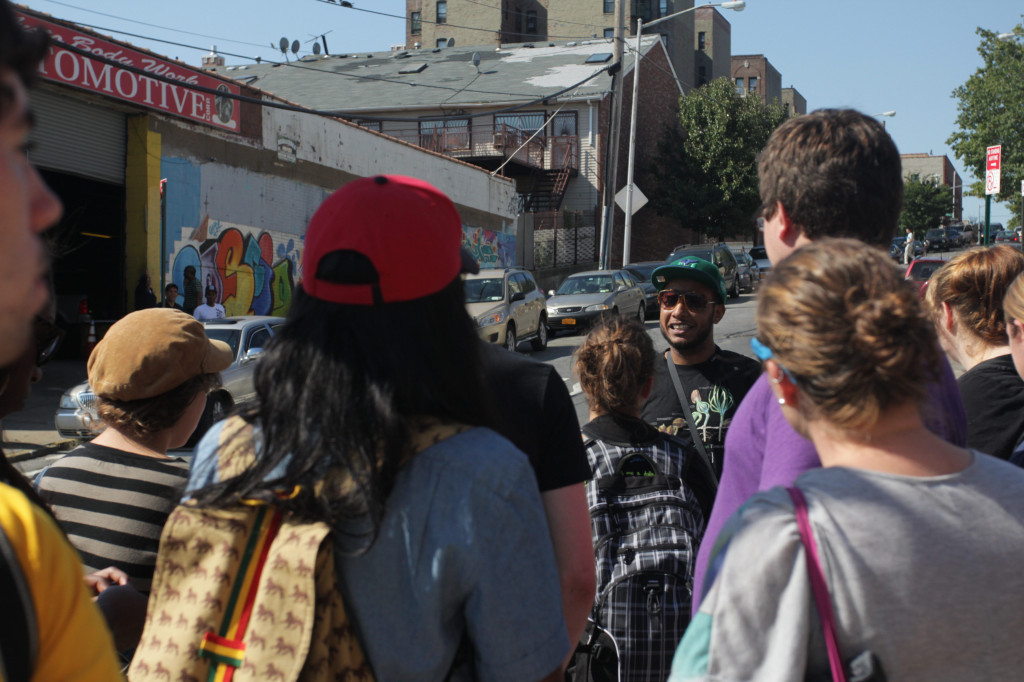
On a brilliant fall day, 25 students on a social justice field trip from Bowling Green, Ohio, visited the South Bronx, but not for the zoo or the Botanical Gardens.

Led by Julian Terrell of the Bronx faith-based group Youth Ministries for Peace and Justice, the students made their way to the graffiti Wall of Fame stretching between East 174th Street and West Farms Road. They watched as Long Island-born graffiti giant Phetus, balanced on a ladder, put the final touches to his new mural.

This artistic history, which has existed for decades, is slated to be demolished to make way for a multi-billon dollar housing project by developers Signature Urban Properties. It will be the biggest project of its kind since Co-op City was built in Baychester in the sixties and is expected to provide 1325 units, half of which will be built as subsidized, affordable housing. Building work will begin next year and is planned for completion in seven years.

“This is literally where the Bronx was burning in the seventies,” said Signature principal Robert Frost. “Our goal is to turn around a non-functioning industrial zone by developing affordable workforce housing.”

The project, which allocates land for a new elementary school, children’s playground and two open public spaces, has the support of locally elected official Joel Rivera.

“Affordable housing is one of the biggest issues faced within our community,” said Rivera. “We are excited that this project will help to address this need.” With poverty rates in the Bronx hitting 12 percent and the fear of foreclosure growing as families get priced out of their own homes, the need for affordable housing is growing.

The Bronx borough president said he is pleased that the apartments will provide jobs and housing for a balanced, mixed income community.

But not everyone welcomed the news. “In trying to provide affordable housing, they’re smacking people in the face and stealing their culture,” Julian Terrell told the visiting students. “We call this a shrine, people come here from all over the world.”

The East Tremont and West Farms area has long languished with derelict manufacturing warehouses and graffiti culture. But some locals fear this housing project may be too pricey and will serve to push out the longtime low-income residents.

Terrell believes that the area became attractive to developers because groups like Youth Ministries worked hard to make it that way. On the other side of the Sheridan Expressway, the locally designed Starlight Park is nestled on an old industrial site by the Bronx River.

The 10 high-rise buildings proposed by Signature Urban Properties on a five-acre area could block local residents’ view of the park and the river. The development company, headed by former City Council member Gifford Miller, also promises to provide over 400 jobs in 46,000 square feet of retail space.

David Frost, a principal of Signature Urban Properties, said this location was chosen from a portfolio of possible options that had the necessary open space, transportation links and “ease of assemblage” – or buildings and land that could be bought easily from current tenants. “There are no jobs there; there’s no business there,” said Frost. “Our land is vacant.”

While Frost insists that the developers have support from the local community, some residents think otherwise. Cerita Parker, a retired Board of Education worker who lives on Longfellow Avenue, is worried that the community will be destroyed by the new plans.

“Throughout the Bronx we have seen a rebirth of communities with new building going up and lots of them are not affordable,” Parker said. “When you start building housing that’s out the price rage of local residents, these residents get kicked out.”

At the department for city planning, which is currently receiving funding to research ways to decommission or modify the nearby Sheridan Expressway, the new development is big news. “The way we think of this whole area is different because of this project,” said Ryan Singer from the Bronx office. “We asked Signature if they were worried about the Sheridan and they said they were prepared regardless.”

Plans to decommission the 1.2 miles of the Sheridan Expressway, which links the Bruckner with the Cross Bronx Expressway, reached a stalemate last year when the state cited a study that showed local traffic would worsen if it were removed. Frost, of Signature Urban Properties, refused to speak out against the Sheridan but did say: “Depending on how the Sheridan was decommissioned, it could be something we could get behind.”

The volunteers at Youth Ministries have been lobbying for the removal of the highway for over a decade. “We don’t want their support,” said Terrell at the suggestion that Signature might be able to help.

As for the graffiti, Frost said Signature is thinking of finding a small space in the new plans to designate a canvas. “That’s one of the coolest things up there,” he said.

When the squat manufacturing warehouses, which currently include towing merchants and a hog dog vendor, have been removed, it may be too late to save the graffiti culture here. At Da Bakery, a world-renown graffiti shop on the corner of the site, artists had no idea of what was planned.

Parker said that’s because the developers have not tried hard enough to reach the local community. “The only people that Signature has courted is the community board and the assemblymen,” she said. “They haven’t consulted the community whatsoever. It’s another example of money talking and everyone else following.”

Posted in Bronx Beats, Bronx Life, Culture, Featured, Housing, Southern Bronx, The Bronx Beat, TransportationComments (0)

fist of fight back program

Fighting their neighborhood

The Fight Back Program is a 10-year-old jiu jitsu and self-defense program run out of the Mary Mitchell Center in the East Tremont and Crotona neighborhoods. Its senseis have trained hundreds of local kids to use martial arts to resist negative pressures all around them.

Posted in Bronx Life, Bronx Neighborhoods, Featured, Multimedia, North Central Bronx, Sports, VideoComments (0)

Tenants sue landlord for moldy building, NY Daily News

Tenants in an East Tremont building announced Thursday that they were suing their landlords over the living conditions in their apartment, reports the New York Daily News.

The building at 2097 Webster Avenue, they say, has been plagued by leaks, cockroaches and rats.

The tenants are hoping for a Bronx Housing Court to appoint an administrator to manage the building. Housing court judges can appoint private administrators to unsafe buildings under state law.


Posted in NewswireComments (0)

On the Corner: Day laborers hit hard by the recession

Roberto Pareja wait for work on a chilly October morning. Photo: Yiting Sun

Roberto Pareja waits for work on a chilly October morning. Photo: Yiting Sun

At 7:15 on a chilly October morning, a 33-year-old Mexican immigrant leaned against the shuttered door of Kennedy Fried Chicken, a worn-out backpack filled with wrenches and tape lay next to his feet.

Roberto Pareja positioned himself across the street from the Benjamin Moore paint store in East Tremont as he had done nearly every day for years, hoping one of the contractors leaving the store would hire him.

Two hours later it began to rain, and the father of two ducked under a deli storefront. None of the customers needed his help that day, nor the help of 20 other day laborers waiting with him. But he did not want to leave.

For Pareja, no work meant worrying about his $960 monthly rent, food for the six people in his family, and dolls for his young girls.

Pareja is one of almost 100 day laborers who have congregated for years on the corner of East 180th Street and Third Avenue. On a nice sunny day, almost all of them will gather, but on this rainy morning, only 20 tried their luck. The New York Immigration Coalition estimates there are about 10,000 day laborers in the city. Some of them have been in the underground labor pool for years. Others are newcomers driven here by the recession.

“There is less work this year than last year,” said Corinne Beth, an immigration lawyer that supports day laborers on behalf of the Westchester Hispanic Coalition, a not-for-profit organization. She added that with the group of day laborers she helps in Portchester, if five out of the 30 men get work in a given week, they are lucky.

Even though the National Bureau of Economic Research declared an official end to the recession in September, the day laborers’ predicament is far from over.

“The recession hits day laborers harder than it does people with full-time work,” said Lynn Svensson, director of the Day Laborer Research Institute. Of the estimated 260,000 individuals working as day laborers in the United States, approximately 75 percent are undocumented immigrants, according to “On the Corner,” a study by the University of California at Los Angeles in 2006. The study found that their immigration status and the lack of English skills are the biggest impediments in finding more stable work.

Since the recession began in December 2007, the number of day laborers at this spot has increased, said Bob Ascat, the paint store manager who has seen them for the last decade. Local contractors drive by the corner looking for workers to assist in construction work. For a worker who does not have a business relationship with a contractor, he relies on customers from the paint store who have home projects to complete.

But the work available for them has decreased as more people compete for a shrinking pie. In 2009, the Pew Hispanic Center, a nonpartisan research organization, reported that the unemployment rate for foreign-born Hispanics in the fourth quarter of 2008 was 8 percent, a 3-point increase from the same period in 2007.

Although immigration status was not recorded for the report, the center estimates that undocumented immigrants account for about five percent of the U.S. labor force. In certain industries such as construction, which is the primary industry for day laborers, undocumented immigrants account for 12 percent of employment. Most undocumented immigrants are from Latin American countries, with 55 percent coming from Mexico.

“Life is difficult,” said Pareja, who emigrated to the United States from Mexico eight years ago. “There are times when you don’t find work, and even more now that things have gotten harder.”

His family is still suffering from the recession’s consequences. A month ago his wife started selling Mexican tamales by the dozen to acquaintances with the hope of earning the family an additional $150 a week.

When there is no work, Pareja supports his family with savings and relies on his father-in-law, who assists him in some projects, to pick up half of the rent when necessary. Every single workday counts for him because coworkers may learn of his skills and recommend him for contract jobs.

A week after that chilly Monday morning, Pareja found a contract job with the help of a friend he met through work. He would earn $450 a week for six weeks remodeling apartments on 1st Ave near 60th St in Manhattan.

But work comes sporadically for Pareja, who may have a week with only two to three days of work, other weeks nothing. “No one can survive on that,” said Svensson. “ Bosses are paying less now, their wages have actually gone down.”

There are also day laborers in the underground economy who may not get paid for days and even weeks of work when contractors use a person’s immigration status as an excuse to withhold payment.

“They threaten you with sending immigration, and you can’t turn somewhere else for help,” he said.

“Day laborers are often the targets of exploitation,” Svensson added. “They are often paid less than they were promised, or not paid at all for their work, and told by employers that if they call the police that they will be turned in to immigration.”

What makes the situation worse is day laborers often do not know enough about their rights. “They have no sense of empowerment,” said Beth.

Other day laborers in this Bronx intersection have also been cheated out of money by dishonest contractors. According to the UCLA study, 54 percent of day laborers in the Eastern United States have not been paid for their work.

In a more recent study released this past summer, the Seton Hall University School of Law surveyed 26 day laborers (approximately half of the workers) at the corner of Stockton Street and Wilson Avenue in Newark. Ninety-six percent of day laborers at this East Ward intersection, located less than 40 minutes from the Bronx, reported instances of nonpayment or underpayment from contractors.  These regional and local reports exceed the 48 percent reported nationally for day laborers who have lost wages, and in Newark the majority of them have lost $800 or more.

“They have accepted wage theft as a cost of doing business,” said Bryan Lonagan, a Seton Hall law professor who oversaw the Newark study. “There really isn’t an effective avenue for them right now to bring a wage complaint.”

Bronx day laborer Jose Balquiera understands the frustration of losing $800 of wages.  After only a few months in New York City, the 28-year-old lost two weeks and $1,000 when a contractor did not pay him for remodeling an apartment. The person who hired him dismissed any discussion of payment from the beginning, simply saying he would pay him on Saturday, then telling him another day.

“Sometimes they don’t show their face,” Balquiera said, scanning the street for cars pulling up. “They give you their numbers but they don’t answer to not pay you.”

The Toluca, Mexico native has been in the United States for a year, and feels overwhelmed by the language barrier, which often causes day laborers even more fear to enforce their rights. “It feels really bad,” said Balquiera in Spanish of not being able to defend himself when he encounters contractors that do not want to pay. “Imagine, they talk to you in English and you don’t understand.”

Wage theft in New York City amounts to an estimated $1 billion across all low-wage industries, according to the National Employment Law Project. Passed last month in legislature, the New York Wage Theft Prevention Act calls for stricter penalties and the enforcement of laws meant to protect workers.

Although this provides an added resource for workers, the Newark study suggests day laborers are vulnerable to wage theft because they have limited English skills and they fear complaining to the authorities due to their immigration status.

“Most of them expressed fear of the police reporting them to immigration and customs enforcement for possible removal,” Lonagan said of the lack of police involvement.

Lonagan added that if a day laborer submitted a dispute through small claims court, it could take almost a year before the claim was just recognized. The day laborers choose then to seek work to make up the lost money instead of spending days in the process.

Although Bronx day laborers may not seek formal assistance in cases of labor abuse, these workers look out for each other even as they compete for jobs. Demaso Genis said he makes an effort to point out crooked contractors who have stiffed him in the past when they return to the intersection. He wants to make sure others are not exploited and left at construction sites without payment.

“There’s no way to reclaim that money,” he said. “No one is interested in lending us a hand.”

The day laborers support each other in whatever possible small ways. Photo: Yiting Sun

The day laborers support each other in whatever possible ways. Photo: Yiting Sun

Genis said even when contractors actually do pay, every day there is someone different who promises a specific salary only to actually pay less.

The 47-year-old left his wife and two children in Morelos, Mexico more than a decade ago. He said even when the recession might have ended for others, supporting the family is still a struggle for him.

“There are weeks that you can’t even send $50,” he said of this variable work that pays him an average of $80 a day when there’s work.

Remittances to Mexico dropped 20.4 percent from February 2008 to February 2010, according to BBVA Research, a global finance company. After 17 consecutive months of falling remittances, April offered an increase of less then a percentage point. Although remittances continued to increase at a small rate, the improvement slowed in September, and it’s not expected to reach more than two points based on the outlook of the United States economy.

As a result, these day laborers live on as little as possible to send as much money as they can to families in their native countries. Balquiera lives with 11 other men in a four-bedroom apartment, where his portion of the monthly rent is $120.

“When I do find work, I send money; when I don’t…” he stopped and shrugged off the rest of the answer. “It’s difficult here.”

Before the recession hit, day laborers had less competition and more work. With more money to send home, their families invested the money they received in education, businesses and new houses.

After almost 20 years of sending money to his wife and six children in his native Acapulco, Mexico, Cornelio Hernandez, 63, now has his own house in Mexico and is currently putting his youngest daughter through college.

“Everything is done with sacrifice,” he said of not seeing his family for almost two decades. “We come to this country to suffer, to become something.”

Hernandez’s time in New York City has paid off. He is solicited by contractors throughout the city because of the reputation of his work. For the past few summers, a real estate agent has hired Hernandez to work in City Island for the upward sum of $110 a day to remodel apartments. His tired eyes light up and his smile widens when he talks about his children’s professional pursuits.

This winter Hernandez is prepared for more than the harsh winter. According to Svensson, there is less work for day laborers from November to the end of February. Contractors focus mostly on indoor projects such as painting and installing floors.

Pareja said his current contract job is helping him save for those winter months. He still hopes this job could lead to the next so he does not have to spend hours waiting for work in the snow. “We try to do things as best as possible,” he said with his one-year-old daughter on his lap in his home. “If your boss likes your work, he can give you more work.”

Posted in Bronx Life, Bronx Neighborhoods, Money, Southern BronxComments (0)

The Riveras are One in a Million

By Mustafa Mehdi Vural and Jose Leyva

rivera3

The Riveras share their 18th floor apartment with three chihuahuas, birds and a small aquarium. Photo By Mustafa Mehdi Vural

The elevators break down at least twice a month in the Murphy Houses, a 20-story, low-income complex at 1805 Crotona Ave. in the Bronx.

Disrupted service is an inconvenience for all its 714 residents. But a broken elevator poses an extra burden for Francisco Rivera, 31, from Puerto Rico, who lives on the 18th floor with his wife and two children.

Francisco Rivera’s right leg was amputated 13 years ago when doctors found a cancerous tumor on his knee in Puerto Rico. At that time, Rivera was an 18-year-old boxer in high school, and also a husband and father of one daughter.

Doctors at Jacobi Hospital in the Bronx found and removed another tumor in his brain last May, bringing his total number of tumors to 18. After numerous operations, he has lost half of his right lung and part of his groin.

“There are no hospitals in Puerto Rico like in the U.S., there is no such technology,” said Rivera’s 29-year-old wife, Elizabeth, in Spanish. She was 13 when she met Francisco and 15 when she first gave birth to their daughter, Franshely.

“Doctors told me that I had a year to live,” said Rivera recounting their ordeal in Puerto Rico. His cane leaned against the couch. And the walls in the living room were covered with the Puerto Rican flag.

The Rivera family immigrated to the United States in 2000 in search of better medical treatment.

Photo By Mustafa Mehdi Vural

"I am a fighter, I have always been fighting for my life and for my family's well being," said Francisco Rivera. Photo By Mustafa Mehdi Vural

“The doctors say I am a miracle,” said Rivera. “I tell my husband you’re a living miracle, because I’ve seen cases like yours and they just don’t make it,” said Elizabeth.

Francisco survived brain surgery in May, but it has left his vision impaired in his left eye, and visible scars in his skull, which was reconstructed with metal implants.

“I have small memory problems. Right now I’m taking pills to prevent epilepsy,” said Rivera.

On a Monday afternoon in late October, the elevator was out of service again in the Murphy Houses. So the Rivera family had to make it down the stairs to go to Old Navy department store in Co-op City, in the Bronx.

They were not going shopping. They were going to collect a $1,000 gift, along with new clothes as part of Old Navy’s nation-wide project called “One in a Million.”

“It is inspiring to know that such a huge fashion store is interested in helping people like us,” said Rivera. “I think they are recognizing my own efforts to overcome the cancer.”

This project is meant for each store manager to invest $1,000 in his or her community. The company reserved $1 million in total for this nationwide project that hopes to reach out to 1,000 families in need.

“Anything that they can get is a help during this tough economy,” said Jenira Lopez, the store manager of Old Navy in Coop City.

Early in October, Lopez reached out to Ivine Galarza, the District Manager of the Community Board 6, to identify a needy family in East Tremont.

She had many residents to choose from.

More than 40,000 people receive public assistance in East Tremont, which comes to over 50 percent of the population. In the Bronx, overall, 41 percent of the population is on welfare, 10 points more than the citywide average, according to 2008 district profile data.

“Anyone of these families would have been candidate for this award that Francisco Rivera got,” said Galarza.

“I immediately thought of him,” said Galarza. “I know of him and of his family and of his conditions for years. The situation that they are going through is terrible.”

Galarza noted that the city does not do enough to take care of the poor in her district.

“This is unrealistic–$4 a day for a person to have lunch,” said Galarza, pointing to the figure in the official city document called “Guide to Cash Assistance Budgeting.” “At least in this holiday season, we are making one family happy out of 175,000 families that live in the confines of the Community Board 6.”

The Rivera family’s yearly income is approximately $20,400 a year, $1,000 below the poverty line for a family of four. The average household income in the Bronx is $34,031 compared to $53,448 citywide.

Photo By Mustafa Mehdi Vural

The Riveras have been married for 16 years and have spent 13 of those in hospitals. Photo By Mustafa Mehdi Vural

Francisco’s wife is the family’s main income provider. She works 30 hours a week as home health care attendant for Gotham Per Diem. “I take care of patients with cancer,” said Elizabeth. She earns $9 per hour, providing 60 percent of the family’s income – almost $1,000 a month. The rest comes from the Supplemental Security Income, a federal welfare program for disabled people.

“I just can’t work. It wasn’t a decision I made,” said Rivera. He spends half of his time at home and the other half in the hospital. “I cook, clean the house and take care of our kids.”

It is not easy for Francisco Rivera to execute his daily routine tasks without taking a morphine derivative to fight pain.

Nor is it easy to make ends meet.

The Riveras pay $510 a month for a two-bedroom apartment, which means that each of the family members live on approximately $10 a day.

Elizabeth and Francisco know how to be economical and can now pay their bills without problem. But they realize their family’s expenses will increase as the kids grow up.

Franshely Rivera, 14, is a 9th grader in Wings Academy in the Bronx. She is also taking ballet classes. Miguel Rivera, 10, is a 5th grader in CS 92 and he plays Little League baseball in “Caribe Little League,” the biggest league for the kids in the Bronx.

But difficulties over the years have not kept the Riveras away from making long-term plans for the future.

“The only thing I want, I dream of, is that my children finish undergraduate school and raise a family if they want,” said Rivera.

College tuition will be difficult to manage. “We are going to save for the kids’ education,” said Rivera about the $1,000 gift from Old Navy.

Miguel, however, would prefer a plasma TV and Nintendo Wii, the latest model video game.

“My children are respectful, obedient and studious,” said Rivera. He loves to spend time with his kids, who takes Miguel to baseball practice and to school. He even taught his son how to ride a bike with his amputated leg.

“In the next three years I would like to take my family to Puerto Rico, I want my children to know their country and to meet our family,” said Rivera.

Though Francisco has spent his entire adult life in hospitals, it is not a cause for disappointment for him. He said he sees hope in operation rooms, consultations, and the pills that he takes.

“I am still alive, thank God. He has given me the strength to go forward and fight for my family which I adore,” said Rivera.

“I haven’t surrendered.”

Posted in Bronx Life, Bronx Neighborhoods, MoneyComments (1)

Page 1 of 212